We live in a world which often sends messages for women to be smaller, thinner and to take up less space. At Lume, we want to turn this paradigm on its head.
We want to support women to take up space psychologically and physically, to be strong in every way.
When it comes to muscle, the science is definitive: maintaining good muscle mass is one of the most important safeguards for health as we age.
Here’s what we know now more than ever: There is no pill or supplement that can compete with the medicine of optimized muscle mass.
If we don’t prioritize muscle now, we will lose it.
When we frame things in this way, our mindset shifts to “what do we have to gain?”
Maintain strength to sustain health
1. What is strength training?
Strength (or resistance) training is the act of contracting muscles to lift heavy objects or our own bodyweight against the pull of gravity. Strength training improves muscle mass (the ability to exert maximal force), muscle strength and muscle power (the ability to exert maximal force quickly). We can strengthen muscles using resistance bands, medicine balls, and free weights as well as weight-bearing exercises like squats and push ups.
2. Why is muscle important?
As women, we are generally “under-muscled” and not taking advantage of its benefits. As our bone mass declines with age, so too does our muscle mass. Estrogen is a key contributor to muscle maintenance, muscle mass and strength - and as estrogen drops through the menopause transition, so too does muscle. We lose up to 8% per decade after 30 yrs old and this percentage then accelerates at 60. Sarcopenia (see glossary) is a major risk factor for frailty and falls, the latter being the leading cause of accidental death as we age. We cannot understate enough how important muscle is for healthspan.
If we don’t prioritize muscle, we lose it.
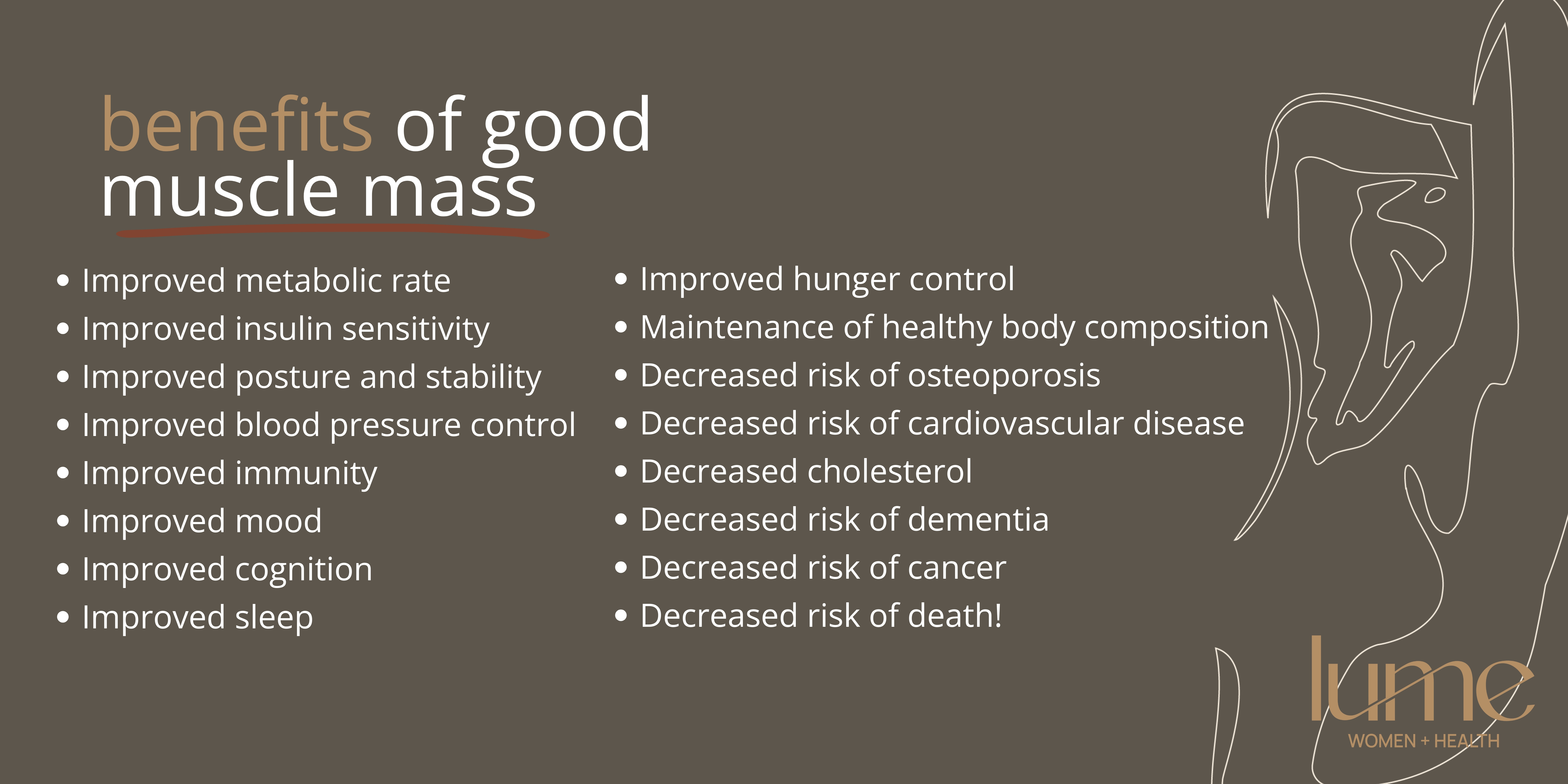
Muscle is medicine: This list of benefits would rival any pill or supplement.
3. How do I incorporate strength training?
A recent Menopause Journal* study shared key factors for success when incorporating a strength training routine:
- Scheduling exercise
- Awareness of exercise benefits
- Self-efficacy "I can do it" belief
- Enjoyment from exercise
- Having weights at home
- Physically active friend groups
- Accountability
- Mental flexibility (not "all or nothing" thinking)
- Pace yourself (injury prevention)
* Menopause Journal: April 2024
❤️ We’re cheering you on !!! ❤️
We know that getting started is hard. This is a marathon not a sprint. Start small — even five minutes makes a big difference over time. Our wish is that you give yourself grace…we build habits by starting really small.
4. How do I strength train?
One approach is to follow the FIIT Principles*
- Frequency: 2-3 times(sessions) per week
- Intensity: 8-10 exercises (like squats, lunges, push-ups) involving the major muscle groups to fatigue. Aim to perform half of these exercises per work-out session, 8-12 times per exercise. Rest for 2-5 minutes and repeat the exercise sequence for 1-3 sets. Set your resistance (weight) to feel difficult but not painful.
- Type: Progressive weight training (free weights or machine-based exercises) or weight-bearing callisthenics.
* Courtesy: American College of Sports Medicine
Glossary
Sarcopenia
Sarcopenia is the age-related loss of muscle mass, strength, and function. It typically begins in older adults and can lead to frailty, increased risk of falls, and reduced quality of life. This condition is associated with a decrease in muscle fibres and changes in muscle composition, which can be exacerbated by factors like physical inactivity, poor nutrition, and certain medical conditions.
