If you take away only one thing from this article, take this:
Start strength training NOW!
Why?
Because strength training is one of the very best proactive things we can do starting in our 30s to counteract the progressive weakening of our bones. We believe that strength training is so important that we’ve dedicated our next two newsletters to the topic.
This article will focus on strength training as it relates to bone health.
For this issue, we want to zero in on osteoporosis - that thing that happens to “old” women, right? Not right, actually.
The truth is that our bones begin to deteriorate in our early thirties.
And, brace yourself: the mortality rate associated with a hip fracture is greater than the mortality risk of all cancers combined.
So, let’s not put this off: now is the time to protect ourselves from unnecessary bone weakening.
How to prevent osteoporosis
1. Get informed
We reach peak bone and muscle mass by age 30 - after that we lose bone faster than we make it. Osteoporosis is a disease characterized by low bone mass and deterioration of bone tissue, which can lead to increased risk of fracture. Known as the “silent thief”, bone deterioration can occur over a number of years without any symptoms. Unfortunately, by the time affected bones break or fracture, the disease is already fairly advanced and less treatable.
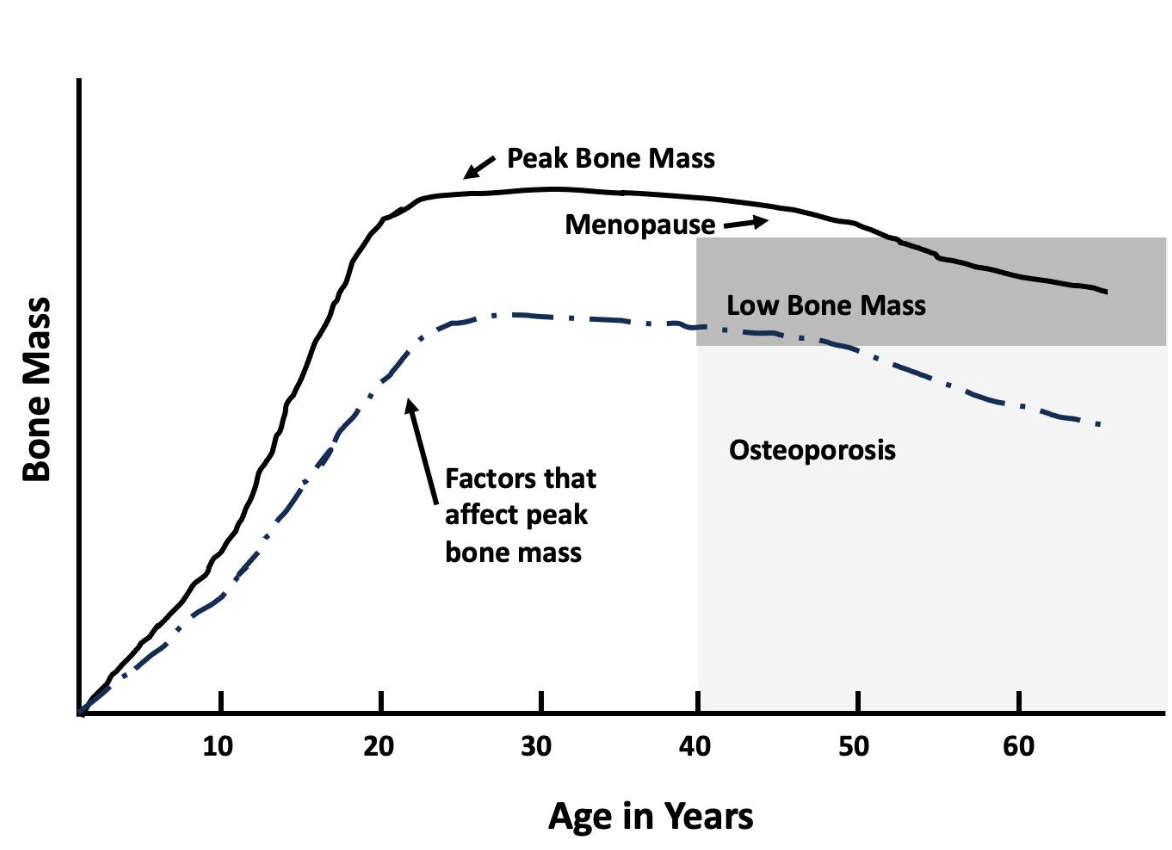
This image illustrates why it’s so essential to do our part to achieve peak bone mass sooner rather than later. Like a financial investment which compounds over time, prioritizing peak bone mass earlier will set us up for compounded bone “wealth” as we age.
The stats are startling…
- 1 in 3 women over the age of 65 are impacted by osteoporosis
- 1 in 5 who fall and break their hip will die
- 1/2 of those who break their hip will never live independently again
The most common fractures associated with osteoporosis are in the hip, spine, wrist, and shoulder. The time to think about our bone health is BEFORE we develop osteoporosis. We can be proactive about this!
2. Screen yourself now
Use this Frax Tool to discover your probability of a fracture.
*Pro tip: Explore with your doctor whether you’re a candidate for additional screening options, like a DXA Scan. The DXA scan is used to calculate your bone mineral density. Visit the FAQ for more on the DXA Scan.
3. Act now to protect your future self
→Strength train: Strength training helps mitigate the rate of bone loss by stimulating increased bone building capacity. While we still lose a little bit of bone mass each year, strength training helps minimize the amount we lose - because we are building bone mass faster than we lose it. Strength training also contributes towards better balance and fall prevention.
So, what even is strength training? Scroll down to On Our Radar for guidelines.
→Lifestyle: Cut out smoking and limit alcohol (sorry!) to 1 -2 drinks per week.
→Supplement: Ensure that you have adequate Calcium and Vitamin D intake. Osteoporosis Canada provides this handy calcium calculator, if you have concerns. Most women are Vitamin D deficient and require supplementation between 600-800 IU/day.
Sources
• Picard, André. “Getting Hip to the Dangers of Fractures in the Elderly.” The Globe and Mail, May 21, 2024.
• Brown, Dr. Jacques. “It is not ‘just a fracture’.” JBMR Plus, Volume 8, Issue 5, May 2024, ziae022.
• Osteoporosis Canada website
