
Breast screening basics
Get. Your. Screening. Mammogram. Now. (Age 40+)
You may think that you’re not at risk, and we’re not here to cause unwarranted worry, but we want to clarify some misinformation around breast cancer, screening, and age.
Here’s why:
1. 17% of breast cancers are diagnosed between the ages of 40-49
2. A screening mammogram will inform you of your breast density. Breast density?! We got you. See the glossary below for a primer.
3. Right now, we are not meeting Canada’s necessary targets for breast cancer screening. In Ontario, for example, only six percent of women in the target group between 40-49 are accessing screening mammograms.
3. Most women diagnosed with breast cancer don’t have any of the popularized risk factors for breast cancer - like family history, for example.
4. A screening mammogram results in earlier detection of breast cancer which:
a) Decreases your risk of death from breast cancer by 40%
b) Decreases your need for extensive treatment like chemo and radiation
c) Decreases the healthcare costs of treating advanced cancers
d) Improves quality of life as a cancer survivor because you got to it earlier
Glossary
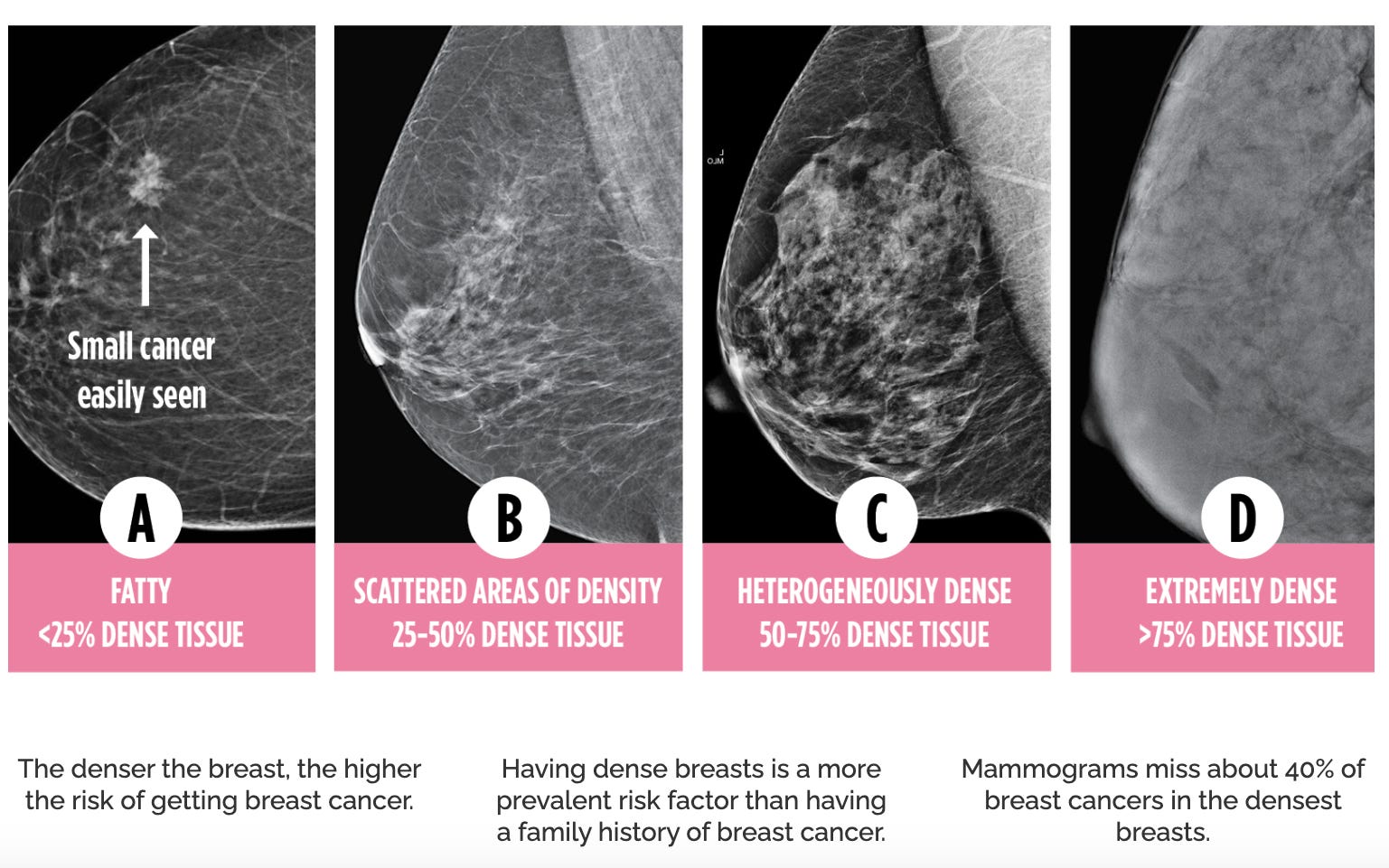
What is Breast Density?
• Determined on mammogram only: you can’t feel it and it’s not related to breast size
• Refers to dense (fibroglandular) tissue vs. non dense (fatty)
• Is an independent risk factor for breast cancer
• Having dense breasts does not mean you will get breast cancer but requires additional screening (like ultrasound or MRI) to minimize your risk
• When you have a mammogram you are sent a breast density report, which can be confusing. You can find more information on breast density here.
What is Menopause?
• The day that a woman has been period-free for 12 consecutive months
• Biologically, a time of neuroendocrine transition where our ovaries are no longer ovulating, resulting in a significant decline in our estrogen levels
• The menopause transition (aka, perimenopause) can last six to ten years for some
